
From Recon Bottleneck to Used Car Factory

Updated: Aug 14
In many dealerships, reconditioning is still treated as a necessary delay, something that happens between acquisition and retail. In high-performing stores, it’s the opposite.
Reconditioning is not a bottleneck. It’s a controlled, measurable production process. And when it’s managed that way, it becomes a direct driver of both inventory turn and profitability.
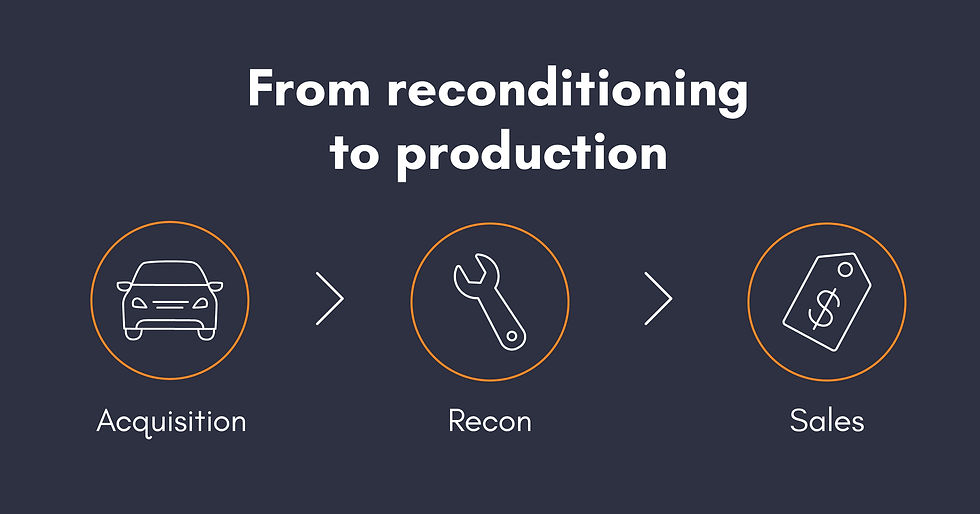
The Shift: From Process to Production
The concept of a “used car factory” is simple: every vehicle moves through a defined, repeatable process, from appraisal to recon to merchandising, without unnecessary delays. That requires alignment across three functions:
acquisition
reconditioning
retail readiness
When those steps are disconnected, vehicles sit. When they are integrated, vehicles flow. The difference shows up in days-to-front-line, inventory turn, and ultimately gross.
Speed Comes from Accountability
Reconditioning speed is not just about capacity, it’s about accountability. High-performing operations track: time from acquisition to recon start, time in recon and time to front-line ready. Every step is visible. Every delay is identifiable.
When that visibility exists, bottlenecks can be addressed quickly—whether they come from parts, labour, or internal handoffs. Without it, delays become normalized.
Owning More of the Process
Another common characteristic of efficient recon operations is greater control over execution. Dealerships that bring more work in-house, especially cosmetic repairs—reduce dependency on external vendors and shorten turnaround times. The result is not just faster recon, but more consistent output. More importantly, it allows the dealership to control costs, maintain quality standards and get vehicles retail-ready faster.
Why Internal Acquisition Changes the Equation
Reconditioning efficiency becomes even more impactful when paired with internal sourcing. Vehicles acquired from service customers, existing clients or street purchases come with a key advantage: history and transparency.
Compared to auction units, these vehicles are easier to evaluate, more predictable in recon and often more profitable.
When acquisition and recon are aligned, the entire process becomes more efficient—from the first appraisal to final retail.
Closing the Loop Between Service
and Sales
The most advanced operations create structured programs that connect both sides, turning service traffic into acquisition opportunities. In practice, this means:
identifying customers in service who may be ready to sell or upgrade
presenting clear, immediate offers
reinvesting part of the service experience into the acquisition conversation
This creates a continuous cycle: service → acquisition → recon → retail → repeat customer. And it reinforces the dealership’s relationship with its own customer base.
Technology as the Backbone
Executing at this level consistently requires more than process, it requires connected systems. When tools like vAuto, iRecon, and Activix CRM platforms are integrated:
appraisal data feeds recon decisions
recon progress is tracked in real time
merchandising reflects actual vehicle condition
follow-up and prospecting are automated
This eliminates manual gaps and ensures that information flows across the operation. The result is consistency at scale.
From Inventory Management to Production Management
The underlying shift is conceptual. Used car departments are moving from managing inventory to managing production. Vehicles are no longer just acquired and listed—they are sourced intentionally, processed efficiently and brought to market quickly.
Dealerships that adopt this mindset reduce time to front-line, improve turn, and create a more predictable operation.
Bottom Line
Reconditioning is not where deals slow down, it’s where performance is defined. When acquisition, recon, and merchandising operate as one continuous process, the dealership gains speed, control and consistency. And in today’s market, those three factors are what separate stores that react from those that operate with precision.


Je cherchais la valeur d'une pièce rare que j'avais trouvée dans les coussins de mon canapé et j'ai cliqué sur un lien d'image cassé sur un site de collectionneurs. Je voulais juste une vérification rapide du prix, mais le serveur d'images était complètement en panne. La redirection m'a mené à une page de cam sex qui était radicalement différente d'une base de données numismatique. Une femme triait une énorme collection de timbres vintage tout en portant une veste en tweed moulante. Le public français dans le chat donnait des pourboires pour deviner le pays d'origine avant qu'elle n'enlève sa veste. Ce qui a attiré mon regard, c'est la façon étonnamment méticuleuse dont elle manipulait les délicates pinces à timbres. J'ai apprécié…